
The Hidden Layer: Programming
A visual of the different between the hidden layer of programming and the output layer of training.


Programming: The Hidden Layer
In a recent conversation, we unpacked how two terms often tossed around interchangeably—training and programming—are profoundly different. Misunderstanding this distinction creates real life limiting constraints. Take the San Francisco 49ers’ Reactive Strength Problem, where recurring connective tissue failures and neural-biological asymmetries have amplified into a multi-season constraint, limiting emergences of high performance even amid treatment and training. Maybe it is the programming, that is missing?
Most in treatment or training for high performance begin by learning the act itself. We master the methods, the intensities, the essence of a well-executed session…that we’ve inherited. We become adept—often exceptionally so—at delivering this work at the output level. Yet a deeper layer—the hidden layer, remains hidden, that is until enough output layer experience compels us to know there is in fact something deeper.
What is deeper? It is programming—the hidden layer. Look for yourself.
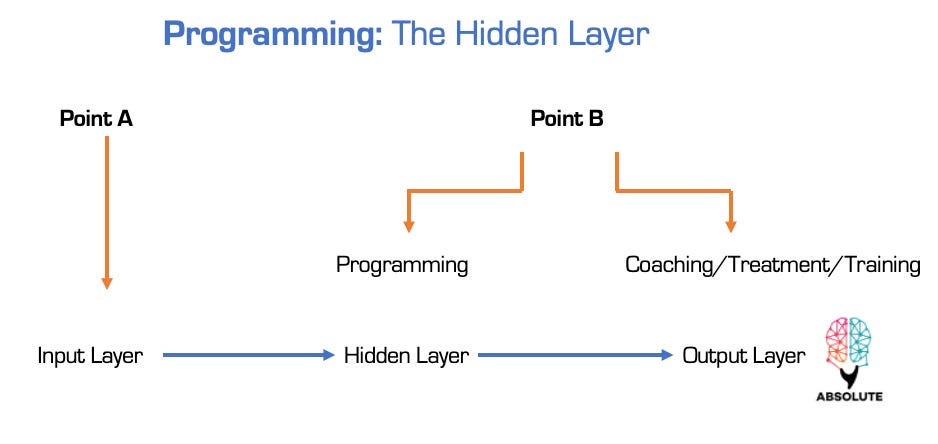
Point A as the input layer, Point B as programming and the hidden layer, and the output layer as coaching/treatment/training.
The Evolutionary Path
Training emerged first, both historically and practically. It’s the output layer—the direct biological and neurological inputs (the work) that stimulate the neurology and biology in the real time of training or. Our lineage at Absolute is derived from the Soviets rather than purely Western origins; in our strategy, everything stems from the old Soviet methods: max effort, dynamic effort, and repeated effort methods.
The Soviets were so right that the methods have stayed the same even in 2026. The inputs generated from these origin methods keep evolving rapidly at various levels—external and internal—but their core logic was largely refined decades ago in the labs and gyms that gave birth to Training Science. You can master them, execute them optimally, and still instinctually know that with certain clients, you’re only scratching the surface—that’s because you are.
This hidden depth is like the neural network of absolute strength, where the central nervous system (CNS) acts as literally the hidden layer—processing sensory inputs like training, treatment, nutrition, stress, rest, hormones, and injury to orchestrate outputs—emergent behaviors, feedback loops.
In our conjugate strategy, treatment integrates with these training inputs. Treatment is always stimulatory. For instance, we utilize repeated efforts in clinical settings leveraging the Internal Isometric Continuum to cultivate reactive strength with treatment. We leverage the neural network toward maximal outputs, acquiring more joint range of motion as new nodes in the neural network of absolute strength—see the Louie Simmons Case Study.
The Emergence of Programming as Strategy
Programming arrived later as a distinct evolution. It is the organizational intelligence that arranges treatment and training over time. It is less about what you do in a single session and more about how the session is sequenced in real time, how that session integrates with one prior, the ones after, how they accumulate, and how that work has to conjugate to propagates the athlete to something larger—to Point B.
Ever wonder why your client doesn’t get closer to Point B despite the perfect session? This is where strategic thinking becomes indispensable. Point B is not a collection of isolated special strengths to be optimized independently—they are entangled; it is an ecosystem.
Training + treatment supplies the loading and stimuli. Programming manages them in real time and over time—the flows, sequencing, variation—so the ecosystem that is Point B doesn’t tip into asymmetry, degradation, or stagnation. It respects the hidden biological-neurological symmetry. How today’s programming influences tomorrow’s physical state, how one capacity supports and amplifies or interferes and dampens with another, how the client’s life constantly rewrites the variables.
Many highly competent coaches and therapists never consciously cross into this territory. They are masterful at the craft of training/treatment yet remain planners when it comes to long-term strategy. The result is familiar: stacks of new protocols, endless research rabbit holes, clients who improve but never quite reach that unconstrained state we sense is possible. The information doesn’t integrate and conjugate; it accumulates. In short time, it becomes overload—more data, more tools, but no clearer map from Point A, to Point B—the neurologically and biologically unconstrained version of themselves.
Become a Programming Strategist
Ready to evolve from technician and planner into strategist? Dive into our Art and Science of Programming learning module—where we break down conjugate strategies, adaptive sequencing, and real-time Point A Point B ecosystem management.

The Progression to Strategist
